
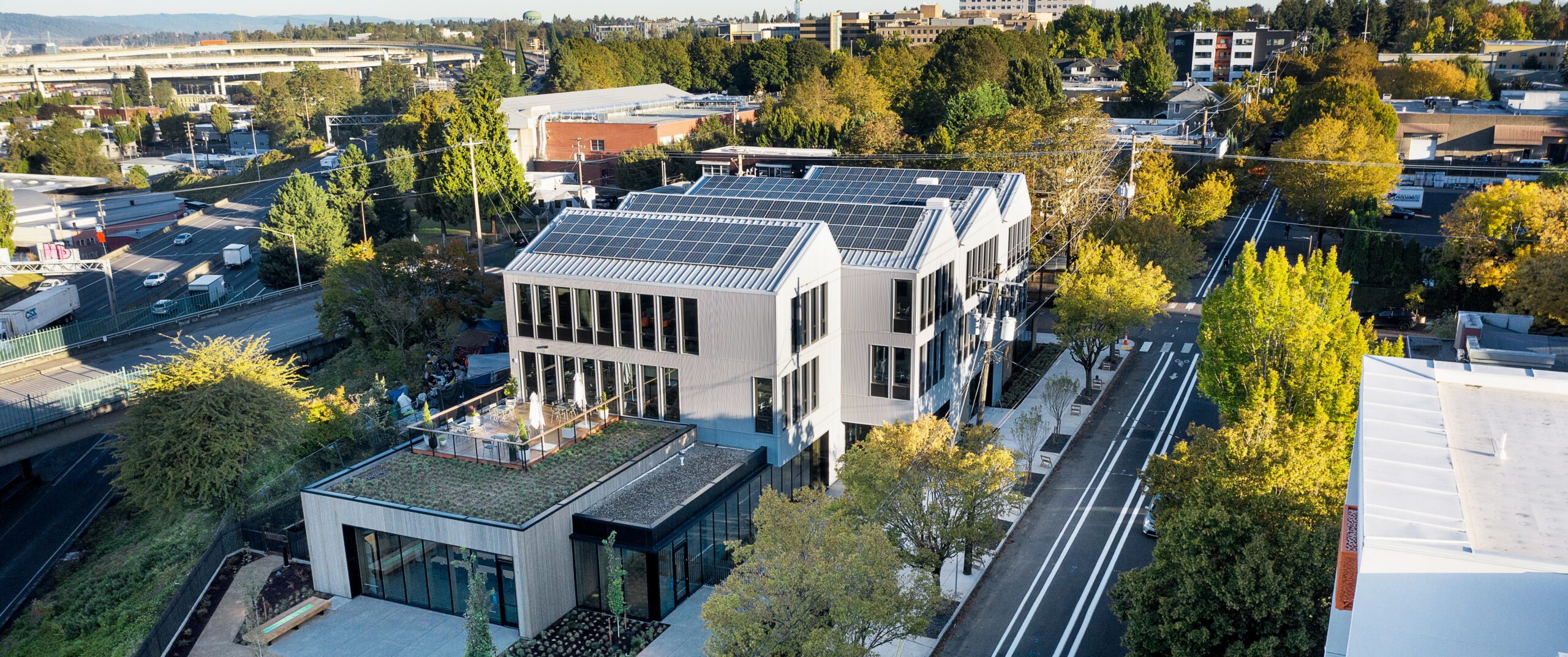
Resilience has become one of the defining challenges in building design, but too often the conversation stops at good intentions. For Nick Pedersen, Senior Distributed Energy Resources engineer at Glumac, resilience starts with a clearer understanding of risk, cost, and consequence. In this conversation, he explains why on-site power, distributed energy resources, and a broader view of building performance are becoming essential as grid instability, extreme weather, and pressures grow. From hospitals and schools to data centers and commercial buildings, Pedersen makes the case that resilience is not a luxury add-on. It is a practical investment in continuity, safety, and long-term value.
To start, tell me a bit about your background and what you do at Glumac.
Nick: I am a Senior Distributed Energy Resources (DER) engineer. DER stands for distributed energy resources, so I focus on projects that involve on-site generation and storage, things like solar PV, battery storage, fuel cells, linear generators, and electric vehicles. I am an electrical engineer by training, but what I really enjoy is that this role lets me work across both the energy team and the engineering team. I have a pretty diverse background too. I earned a BS in electrical engineering, picked up an MBA while I was working, and spent time in industrial automation, technical consulting for consumer electronics, MEP, performance contracting, and DER and microgrid systems. Now, bringing renewable energy and resilient electric power to building owners is the part that feels especially meaningful.
What led you to focus on this area? Where does the passion come from?
Nick: Around 2012, I was working on consumer products. I had a great job and the company treated me very well, but after a lot of reflection, I realized I wanted to do good with the education and experience I had, and I wanted to put my PE license to better use. That is what pulled me toward energy. Once I got into building systems and DER work, it clicked. There is a real opportunity to make buildings better, modernize older buildings instead of replacing them, and help clients respond to growing pressure on the grid and from climate-related disruptions.
When we talk about resilience in the built environment, how should the industry be approaching it? What are we still missing?
Nick: The first thing you learn in this industry is that cost and value drive everything. Clients may have the best intentions in the world, but every project has a maximum budget, and resilience almost always adds first cost. What we are missing is the cost of consequences. Too often, we try to make the case for resilience emotionally when we really need more empirical data and clearer financial arguments. If a factory is down for three days, what does that cost? If a school closes for two weeks, what does that do to students, families, and the surrounding community? If a hospital loses power, what is the real cost of that failure? Those are the questions that should be front and center.
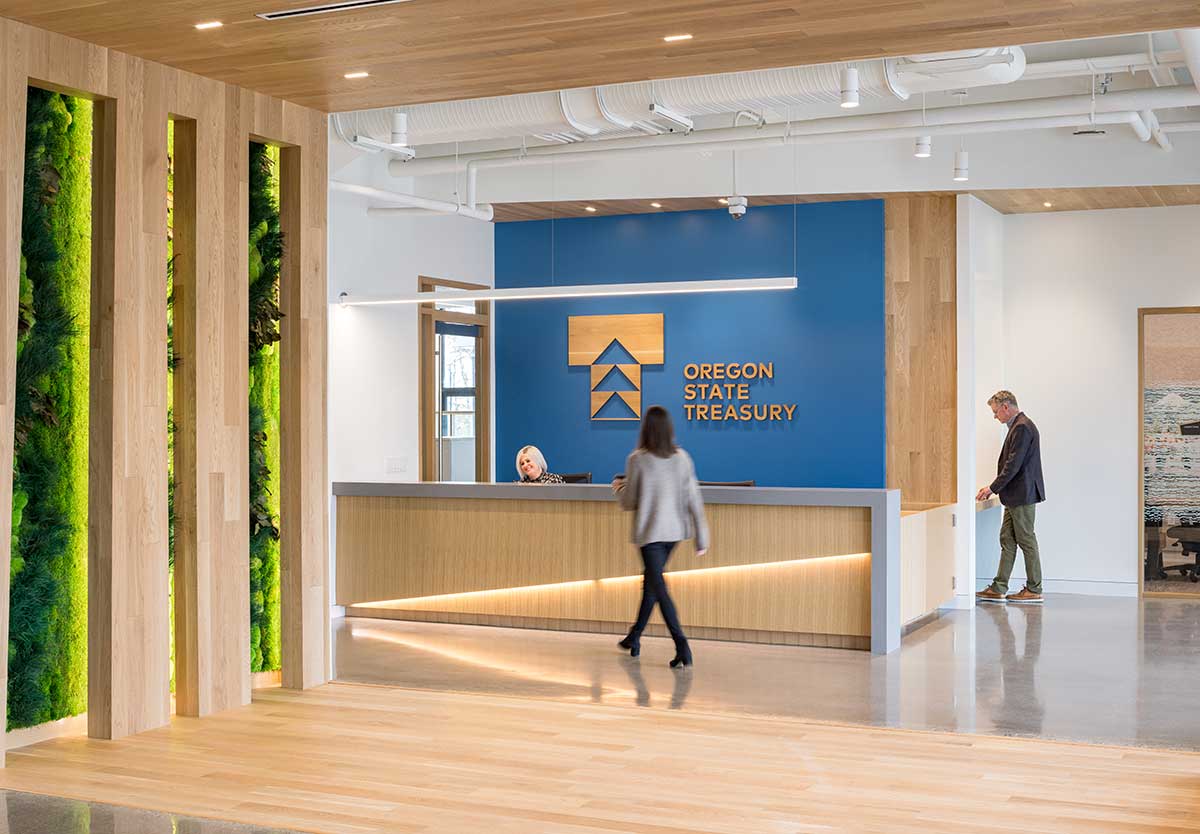
Learn more about our resilient design work at the Oregon State Treasury HQ.
You mentioned a hospital project that has stayed with you. What happened there?
Nick: The state had threatened to shut that hospital down several times because of damaged and insufficient electrical gear. We developed a proposal to fix the system and add resilience for likely risks like long-term outages, sea level issues, and tidal events. The project was close to $1 million. The CEO told us, essentially, “I can spend $1 million to make the state happy, or I can spend it on an MRI machine that brings in revenue.” I was stunned. In hindsight, I wish I had been ready with a much stronger financial argument, one that laid out the cost of a multi-week shutdown in dollars, community impact, and public health. That experience really sharpened for me how often resilience loses out when owners only see the upfront expense.
There is that statistic that every $1 spent on resilience saves $13 later. Are the numbers still too squishy, or do people just not grasp what they really mean?
Nick: Honestly, both. As an engineer, I will always say broad statistics like that are a little squishy because you can poke holes in them. But they are still useful. They give people a place to start. The challenge is that a single business owner is usually looking at their own P and L (Profit and Loss), not total economic impact across a community. So when they hear that $13 figure, they may think it is too abstract. What we need to do better is connect those larger numbers to specific operational consequences. Data centers understand that instinctively because they know exactly what downtime costs. Other owners should be asking the same question. And many of the consequences are not purely financial. If a school shuts down, what happens to learning time? What happens to a parent who suddenly has no childcare and cannot go to work? We do not do enough to quantify those ripple effects.
It sounds like part of this is really a mindset shift, from viewing a building as a standalone asset to seeing it as part of a larger ecosystem.
Nick: Absolutely. I have always believed you get what you measure. If an owner measures revenue and cost, then everything else becomes secondary. But buildings do not exist in isolation. If one building stops operating, or goes vacant, it affects the buildings around it, the businesses around it, property values, safety, and tax revenue. We tend to focus on how something affects me instead of how it affects my neighbor, and resilience pushes against that. It asks us to think more broadly about the role a building plays in a community.
How much do geography and regional risk change the way you consult on resilient design?
Nick: On the surface, geography matters a lot because the hazards are different everywhere. But once you get below that first layer, the more important question is what the building is there to do every day. A county office building in Santa Monica, Chicago, or Houston still has a mission. The same is true for schools, hospitals, factories, and residential buildings. Twenty years ago, geography was harder to account for because the information was not as accessible. Now there are strong resources online, including the U.S. Climate Resilience Toolkit and the Technical Resilience Navigator, that make hazard information and mitigation strategies much easier to understand. So today, the more actionable conversation is often about the client’s operational goals. If the client loses power for three days, what happens? Does it put lives at risk? Does one day of downtime cost more than installing a generator?
What are you reading on this subject right now?
Nick: It’s 10 years old now, but a book I come back to a lot is The Grid by Gretchen Bakke. The book does this long dive into how our grid came to be and how it’s something we completely take for granted today. But it changed our country. And it’s a marvel that it was built. But, we’re just not maintaining it. And that’s a big problem. One great anecdote from the book that I particularly liked, though, is a section where Bakke talks about how Edison is known for making a cost-effective light bulb. But at the time people didn’t have electric power in their buildings. And so, where he really made money was designing generators and installing them in buildings. So around New York City, all the new big buildings would have a generator in the basement. providing power for their electric light. And then one of his proteges took that idea to Chicago and put generators all over Chicago. So, in essence, we actually had had on-site power before we had a grid. Now we’re starting to see a shift in the industry back to this idea of data centers should have their own private power plant. And manufacturing plants needing so much power, and the grid’s failing, so let’s build on-site power for the manufacturing plant. We’re kind of getting back to something that’s already happened, which is a cool way to look at it.

What is next in this space? What should people be watching?
Nick: Data centers are the hottest topic right now, and not just because of their electrical loads. They force people to think seriously about resilience in every dimension. Someone will ask, “Why put a data center in Arizona if cooling is so hard there?” The answer is that Arizona avoids other risks like tornadoes and hurricanes. That tradeoff mindset is important. Owners have to decide which risks they are willing to accept and which ones they need to design around. More broadly, the national gird is failing. In many places it is getting worse, especially as things like wildfire risk grow. That makes on-site power and distributed energy increasingly important. Nationally, there is a shortage of experienced engineers and developers to support that transition, but we will get there. On the more technical side, small modular reactors are one of the most fascinating things to watch. The technology is compelling, but the timeline and economics of licensing and deployment are still major hurdles.