
In the Pacific Northwest, resilient design starts with a blunt reality: many buildings are well matched to the average day and poorly matched to the disruption day.
That gap shows up fast in this region. A winter storm knocks out power, and an all-electric building loses heat with it. Wind takes down distribution lines, and a facility that looked reliable on paper goes dark. Roads ice over, and the problem is no longer just the building system failure; it is the fact that repair crews, first responders, or occupants may not be able to move at all. In the built environment, resilience here is less about dramatic catastrophe than about what happens when ordinary systems fail in a place that is only intermittently stressed but highly exposed when that stress arrives.
That is what makes the Pacific Northwest a distinct design problem. The region often sits in a middle zone: hazards are serious enough to matter, but not frequent enough to make every owner eager to consider in the upfront cost of resilient design. The result is a built environment that can be surprisingly vulnerable precisely because the risks do not feel constant.
Key Risks in the Pacific Northwest
For designers and owners, the most useful framework is not simply “what hazards exist?” It is “what hazards create the most building-level risk?” That means looking at both magnitude and frequency.
The high-magnitude risk in the Pacific Northwest is extreme cold and ice. These events may be infrequent, but they hit the built environment hard. Roadways become inaccessible. Power outages stretch longer because restoration is harder. And because Washington and Oregon rely so heavily on electric heating, a cold-weather blackout can shut off both electricity and space heating at once. In building terms, that is a cascading failure: power loss becomes a thermal comfort problem, then a safety problem, then an operational problem.
The more common risk is the wind-driven outage. In many Pacific Northwest communities, the grid’s weakness is not generation so much as distribution. Overhead lines move through trees, hills, and constrained access routes. Outages may be shorter and less dramatic than an ice storm, but they happen often enough to shape design decisions for facilities that cannot afford repeated interruptions.
Deciding What a Resilient Building Actually Needs
Not every building needs to do everything. The smartest resilience plans usually begin by identifying critical needs rather than trying to harden every system equally.
That is a much more useful question for the built environment: What has to stay on for this building to remain functional?
On a college campus, that may not mean every classroom stays fully operational. It may mean dorms remain habitable, dining stays online, and core communications work. Once those priorities are defined, resilience planning becomes more targeted. That is when decisions about envelope upgrades, HVAC filtration, backup power, or a full microgrid start to make sense in proportion to the actual mission of the facility.
This also helps explain why resilience looks different by sector. A government building may justify a highly redundant system because interruption is unacceptable. A school or civic portfolio may need something more selective. In either case, resilient design works best when it is tied to building function, not an abstract idea of “preparedness.”
key systems to consider
In the Pacific Northwest, resilient building systems rarely come down to one silver bullet. The stronger strategy is usually layered.
One effective model is what could be called pragmatic resilience: use battery storage and PV to cover the vast majority of routine outages, then keep a smaller fossil-fuel generator for the true edge case. In that sequence, the battery and solar system handle the everyday disruption profile, while the generator is reserved for the black-swan event. That can dramatically reduce the size and cost of the battery system compared with designing for the single worst day.
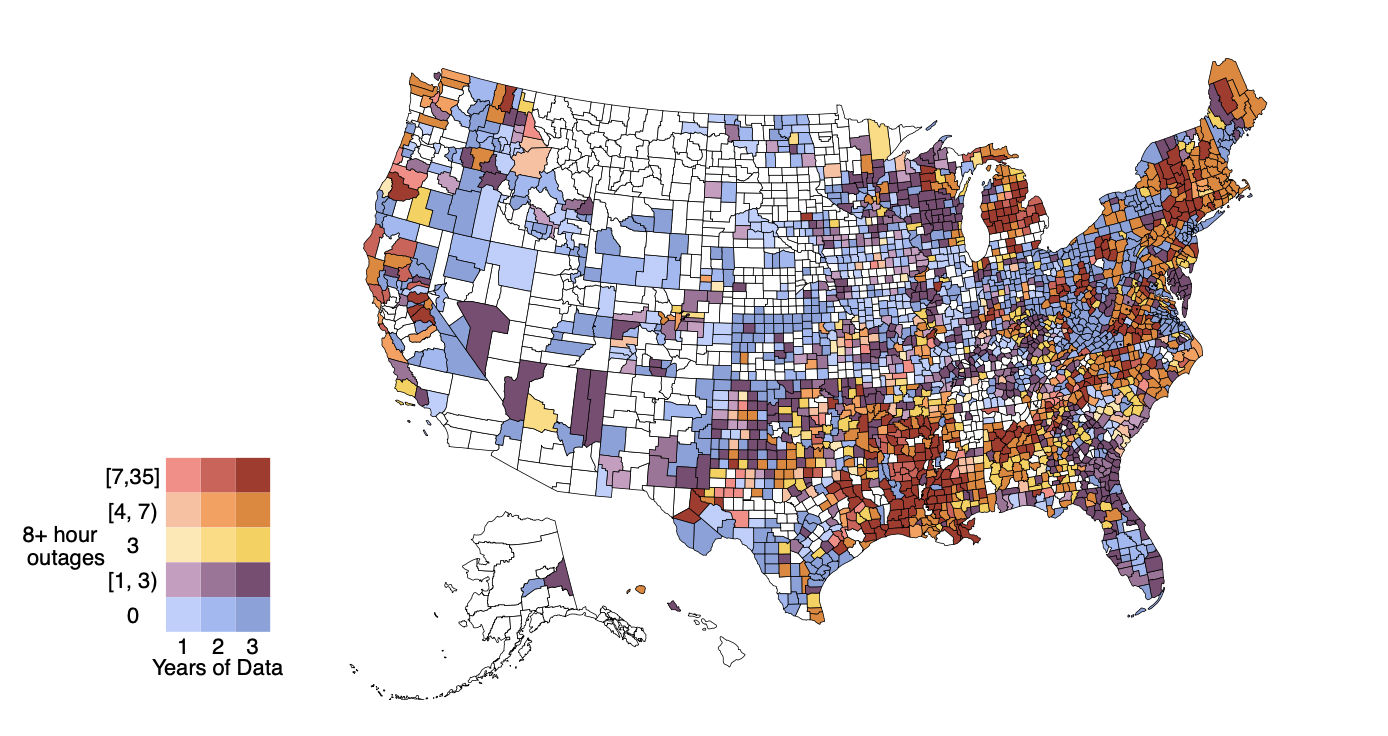
That matters in this region because solar economics are not uniform. Seattle and Portland do not offer the same solar profile as California, while eastern Oregon and Washington can be much more favorable. But even where the solar margin is smaller, on-site energy can still provide building-level value during normal operations by offsetting electricity costs and acting as a hedge against a less reliable, more expensive grid.
The more important point is that resilient systems should match the outage profile the building is actually likely to face. A design that covers 95 percent of disruptions, then uses a smaller backup layer for the last 5 percent, is often a better built-environment solution than one oversized system attempting cover all potentials at the same time.
What Low-Cost Moves Can Make Buildings More Resilient?
Not every resilience investment is a major capital project. Some of the most useful moves are operational.
Temporary generators can be deployed strategically across a portfolio instead of purchasing permanent backup systems for every facility. Written emergency procedures can protect buildings almost as effectively as equipment in the first hours of a disruption: who shuts down what, who calls the utility, where occupants move, which spaces stay operational. Prearranged fuel agreements and utility partnerships can also reduce downtime dramatically because they replace improvisation with sequence.
That is especially important for public portfolios. A library system, municipal network, or campus may get more value from strengthening a small set of buildings into community resilience hubs than from trying to make every facility self-sufficient. In those cases, the building becomes part of a larger operational strategy: a place for heating, cooling, charging, and continuity when surrounding systems fail.
Why Is Resilient Building Design Becoming More Urgent Now?
Because the building case is no longer only about emergencies. It is increasingly about economics.
Electricity prices are rising. Time-of-use pricing is spreading. Utilities are offering more grants and incentives for batteries and microgrids because reducing peak demand can be cheaper than building new generation. That means resilient building systems can now do double duty: save money during normal operation and provide backup during disruption.
At the same time, the region’s future hazard profile is getting harder to model from historical averages alone. Weather is more volatile. Snowpack swings. Heat events and wildfire impacts are growing less predictable. For buildings, that means resilience cannot be based only on what used to happen. It has to be based on what future conditions are likely to demand from mechanical systems, electrical infrastructure, and operations planning.
In the Pacific Northwest, resilient design is not about turning every building into a fortress. It is about closing the gap between what a building is designed to do on a normal day and what it must keep doing when the day comes that the systems around it stop behaving normally.